Why Intact Fluid Inclusions Prove Your Russian Citrine is Unheated
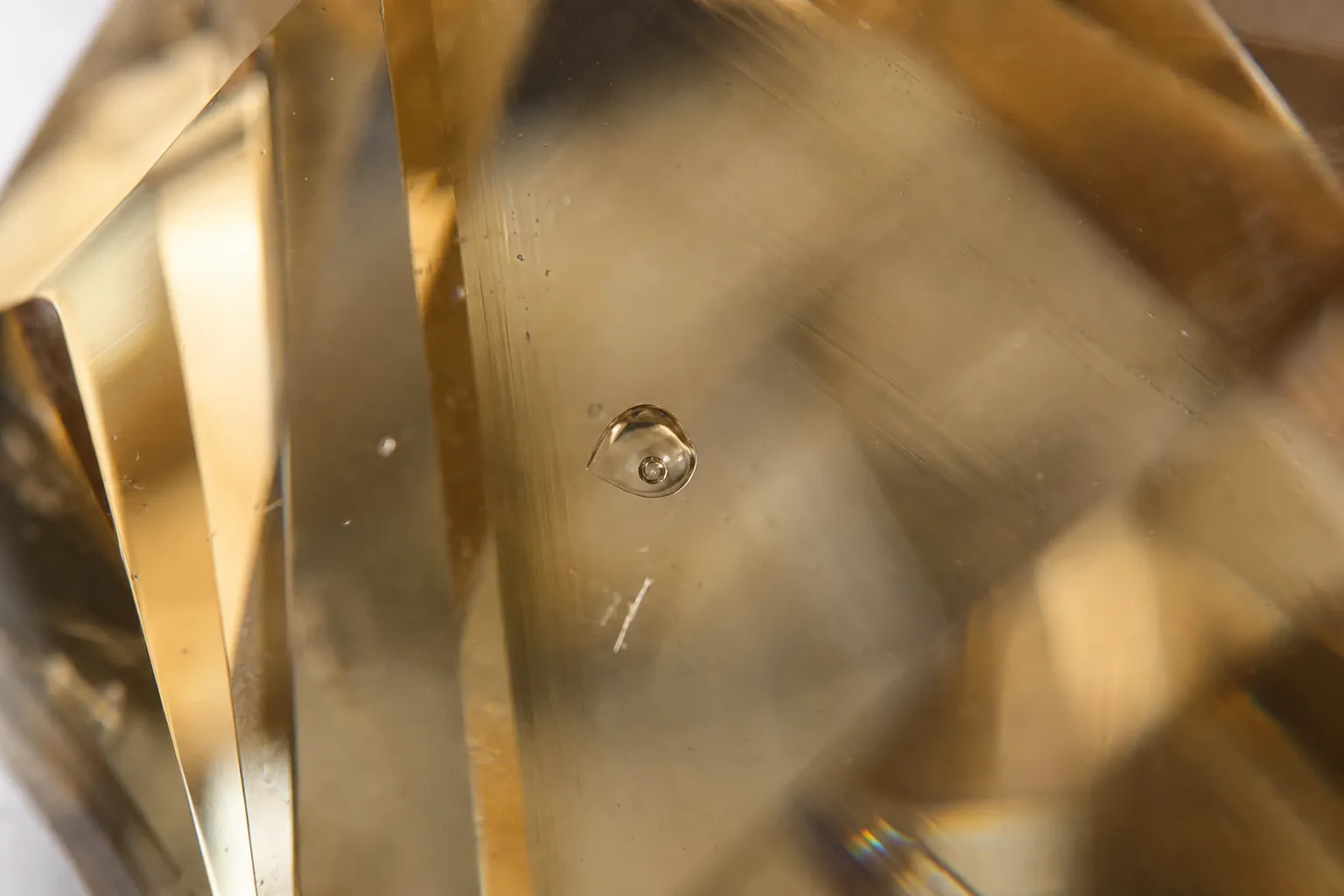
If the “bubble” in your Russian or Ural citrine is a genuine internal two-phase fluid inclusion—liquid plus a vapor bubble sealed inside the quartz—it can be strong evidence that the stone was not heated in a way that disturbed that inclusion system.
That is the practical reason Ural citrine inclusions matter. They can support an unheated interpretation. The conditions matter, though: the feature has to be real, internal, sealed, intact, and read correctly under magnification. A visible bubble by itself does not certify Russian origin, Ural locality, full treatment history, rarity, or value.
broader context
Start with the main citrine page
This narrower page works best after the broader citrine reference page.
What the bubble actually means
In seller language, you may hear “gas bubble in citrine.” In gemological language, the more useful term is usually two-phase fluid inclusion or liquid-vapor inclusion.
Citrine is yellow to orange quartz. Like other quartz, it can trap tiny pockets of fluid during crystal growth or later geological activity. If that pocket contains liquid and vapor, the vapor may appear as a small bubble inside the liquid-filled cavity. When the feature is genuinely internal, it is not a cutting artifact or a decorative mark. It is a sealed remnant inside the crystal.
That matters because heat treatment is common in the broader citrine market. Heating amethyst or smoky quartz can produce yellow to orange quartz colors, which is why buyers ask whether a stone sold as “natural,” “unheated,” “Russian,” or “Ural” has physical evidence behind the claim.
An intact two-phase inclusion can help because fluid inclusions are pressure-sensitive internal systems. With enough heat, liquid and vapor inside a sealed cavity can expand or change behavior. Some inclusions may stretch, leak, rupture, or decrepitate—meaning they lose their original sealed character.
The useful answer is not “any bubble proves everything.” A genuine, intact, internal two-phase inclusion is meaningful unheated citrine evidence because some heat histories would be expected to damage or alter that kind of sealed inclusion.
When Ural citrine inclusions support an unheated reading
The strongest interpretation comes when several details line up.
- The feature is truly internal. A surface-reaching pit, polishing mark, chip, open fracture, or reflected cavity can look like a bubble, especially in a faceted stone.
- It is a real two-phase inclusion. The important structure is a liquid-filled cavity with a vapor bubble. A dark speck, tiny crystal, cloud, veil, or stress fracture is different evidence.
- It appears sealed and intact. Burst cavities, disrupted trails, leaking features, or decrepitated-looking textures weaken the inference.
- The heat claim is framed realistically. The inclusion supports “not heated in a way that disturbed this inclusion,” not “this quartz has never experienced elevated temperature of any kind.”
That last distinction is important. Quartz forms in geological environments that already involve heat and pressure. The buyer-facing question is usually narrower: was the stone artificially heated to alter or improve color?
Research on heat treatment in amethyst is relevant because it explains why citrine buyers worry about heating in the first place. Heating can shift amethyst toward citrine-like yellow colors through changes tied to iron-related defects. That does not mean every citrine is heated amethyst, and it does not mean every heated quartz will show damaged inclusions. It simply makes the treatment question real enough that internal evidence deserves attention.
Why heat can damage fluid inclusions
Fluid inclusions are tiny sealed systems. When a quartz crystal is heated, the liquid and vapor inside an inclusion may expand or shift phase behavior. Pressure can rise inside the cavity. If the quartz and the cavity cannot accommodate that change, the inclusion may rupture, leak, or decrepitate.
That is the mechanism behind phrases such as “heat destruction of inclusions.” It should not be read as a universal rule. Heat does not always erase every inclusion in every quartz crystal. The response depends on the specific inclusion and the heating conditions.
Important variables include:
- Inclusion size and shape
- Fluid composition
- Internal pressure
- Fractures or strain in the host quartz
- Temperature and duration of heating
- Whether the cavity was already open or surface-reaching
This is why intact two-phase fluid inclusions are useful but still conditional. They can be strong evidence against significant heat treatment, especially if the relevant treatment would likely have disrupted them. They do not create a simple rule that “bubble equals unheated citrine.”
For Russian or Ural material, the evidence should stay even narrower. Studies of quartz from parts of the Ural region describe gas-liquid inclusions and heat-related release from inclusions in quartz contexts. That supports the general plausibility of the mechanism. It is not the same as a controlled before-and-after study on gem-quality Ural citrine specimens.
Bubble, origin, and value are separate claims
The most expensive mistake is letting one internal feature answer every commercial question.
An intact two-phase inclusion may help with the heat-treatment question. It does not, by itself, prove that the stone came from Russia. It does not prove a Ural locality. It does not prove that a seller’s label is accurate. It does not prove the crystal is rare, investment-grade, or more valuable than another citrine.
Origin determination is a different problem from treatment interpretation. A stone can contain genuine quartz fluid inclusions and still lack documented provenance. A specimen can be Russian without being from the specific Ural locality claimed. A crystal can be unheated and still be ordinary in color, clarity, size, or market demand.
A good buyer rule is: inclusions are evidence, not certificates. Lab reports, provenance records, and credible seller documentation are separate forms of support. They may agree with inclusion observations, but they are not replaced by them.
There is also a wording issue. “Russian citrine” and “Ural citrine” are not identical claims. Russia is broad. “The Urals” is more specific. A named mine, deposit, or documented collection history is more specific still.
What an intact inclusion cannot prove by itself
A genuine internal two-phase inclusion cannot prove all of the following on its own:
- Ural origin. Locality needs separate evidence.
- No possible heat exposure. It supports the absence of heat strong enough to disturb that inclusion.
- Natural color by itself. Color interpretation needs broader gemological context.
- Market value. Value depends on color, size, clarity, cutting, documentation, demand, and confidence in the claim.
- A complete treatment history. Professional citrine testing can examine inclusions, fractures, color distribution, and other features more reliably than casual magnification.
The inclusion still matters. It belongs in the evidence column, not the final-verdict column.
A practical way to read your stone’s evidence
If a stone is sold as Russian or Ural citrine, treat the inclusion as a reason to verify more carefully.
- Check whether the feature is internal. If it reaches the surface or follows an open fracture, it is not the same as a sealed fluid inclusion.
- Look for a true liquid-vapor structure. A two-phase inclusion should not be confused with dust, a mineral speck, a polishing mark, or a tiny fracture.
- Ask whether it appears intact. Burst-looking cavities or disrupted trails weaken the unheated inference.
- Separate heat evidence from origin evidence. The inclusion may support an unheated interpretation; it does not prove Russia or the Urals.
- Use documentation when the price depends on the claim. For expensive material sold as unheated Ural citrine, ask for credible testing or provenance support.
This keeps the feature meaningful without turning it into a self-issued certificate.
The bottom line
Intact two-phase fluid inclusions can strongly support the interpretation that a Russian or Ural citrine has not been significantly heat-treated, because heat capable of altering quartz color can also disturb some sealed liquid-vapor inclusions.
But the conclusion is conditional. The inclusion must be genuine, internal, sealed, and intact. The heat history has to be interpreted in context. Origin and value need separate support. For a modest specimen, an intact inclusion may be useful buying evidence. For a stone priced around “unheated Ural citrine,” inclusions are evidence—not certificates.