Beyond the Loupe: How Portable Raman Spectrometers Expose Baked Crystals
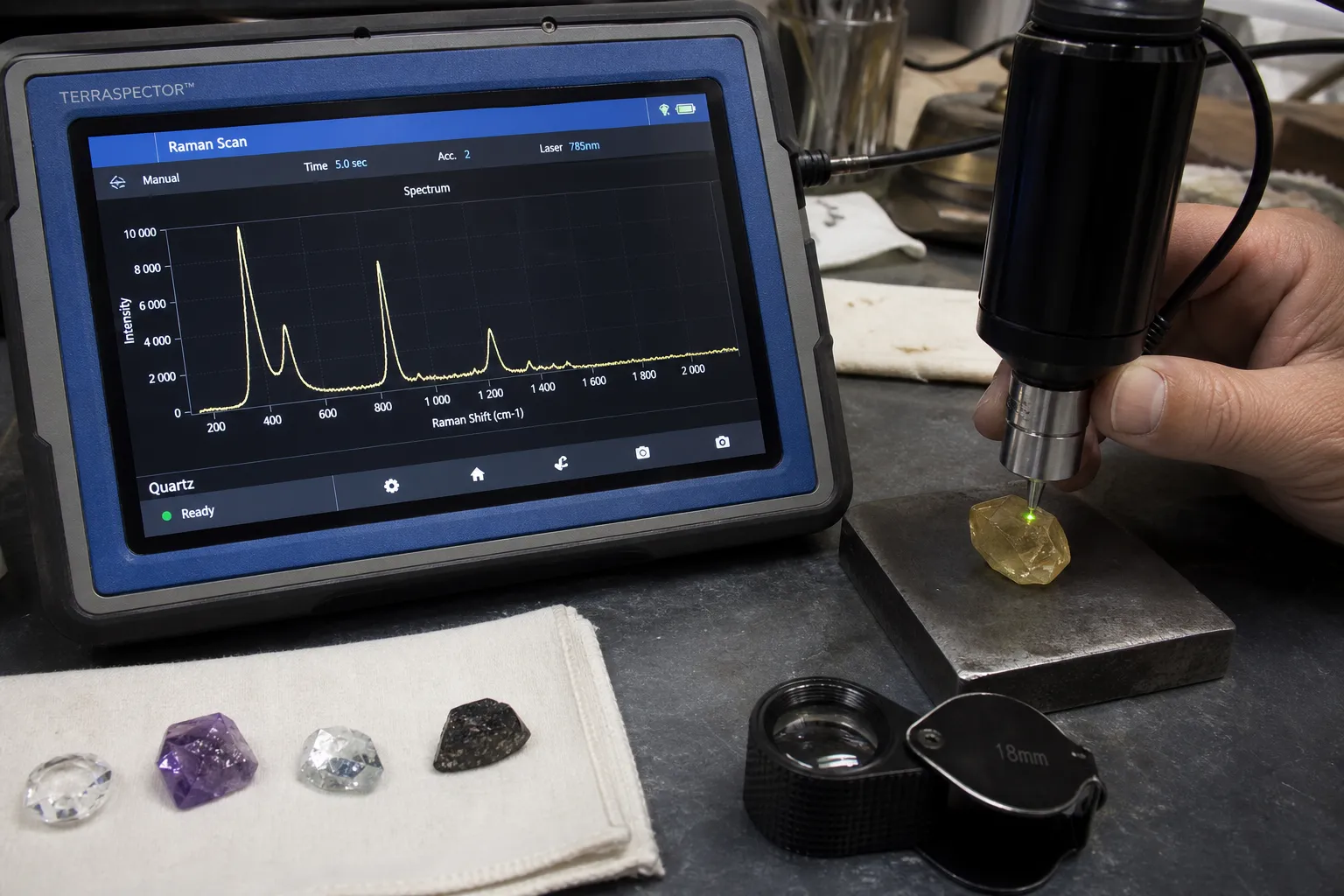
A Portable Raman Spectrometer can help screen crystals beyond what a loupe can show by reading how laser light scatters from molecular bonds and crystal structures. Instead of judging only color, bubbles, surface texture, or polish, Raman testing produces a spectrum that can be compared with known mineral references.
That can reveal a wrong mineral identity, some imitations, certain coatings or residues, inclusions, and—in specific gem species—clues that may relate to treatment. The limit matters just as much: a Raman match can strongly support mineral identification, but it does not automatically prove that a crystal is natural, untreated, or “not baked.”
broader context
Start with the main citrine page
This narrower page works best after the broader citrine reference page.
What Raman sees that a loupe cannot
A loupe magnifies visible clues. It can help you inspect surface wear, dye concentrations in cracks, bubbles in glass, fractures, and some inclusions. It cannot directly read the structure of the material.
Raman spectroscopy works differently. A laser is directed at a small area of the stone. Most of the light scatters back unchanged, but a small portion shifts after interacting with vibrational modes in the material. Those shifts form peaks in a Raman spectrum. In plain terms, the instrument is looking for molecular bond signatures: how that crystal structure scatters light.
For a crystal buyer, collector, or small seller, this is useful because many retail stones are sold by appearance. Yellow quartz may be called citrine. Purple quartz may have been heated to a yellow-orange tone. Glass may imitate a crystal. A coating may create a color the underlying stone does not share.
A Portable Raman Spectrometer does not simply ask, “Does this look like citrine?” It asks, “Does this measured spot produce the Raman laser scattering signatures expected for quartz, glass, calcite, corundum, beryl, or something else?”
That is a real step beyond visual inspection. Raman spectroscopy is widely used in gemological and mineralogical work because it can often identify materials without cutting or damaging the sample. Portable and handheld systems have also been used on gemstones in place, including mounted stones, when the signal is strong enough and the instrument setup fits the material.
But “expose baked crystals” needs careful wording. Raman may expose a treated crystal indirectly when the treatment changes the measured material, leaves detectable residue, reveals a mismatch, or produces species-specific spectral clues. It does not give a universal “heated” or “not heated” verdict for every crystal on a table.
Mineral ID comes first; treatment evidence comes second
The first job of Raman testing is usually mineral identification.
If a stone sold as citrine produces a quartz spectrum, that supports the claim that the material is quartz. If it produces a glass-like spectrum or matches a different mineral, the seller’s description becomes questionable. That alone can be valuable.
Treatment identification is harder. Heat treatment does not always create a simple Raman marker that a portable unit can see. In some materials, heat affects inclusions, defect structures, trace components, color centers, or water-related features. In others, the main Raman spectrum may still look like the same mineral before and after heating.
That distinction is especially important for citrine-like quartz. Natural citrine and heated amethyst are both quartz varieties. A Raman spectrum that says “quartz” does not, by itself, separate natural citrine from heated amethyst. It can confirm the species, but the origin of the yellow color may require other evidence: color zoning, inclusions, growth features, infrared or UV-visible spectroscopy, microscopy, and gemological interpretation.
For some gem species, treatment-related Raman research can be more specific. Heat-treated ruby studies, for example, show that treatment evaluation often draws on several observations rather than Raman alone. That is useful context, not a reason to claim that a portable Raman device can detect every heated stone.
“Is this actually quartz?”
What Raman may help answer: Often useful if the spectrum is clean and matches references.
What it may not settle alone: Whether the quartz color is natural or heat-induced.
“Is this glass sold as crystal?”
What Raman may help answer: Often useful when glass and mineral spectra differ clearly.
What it may not settle alone: Whether every inclusion-like feature is natural.
“Is this coated or surface-colored?”
What Raman may help answer: Sometimes, if the laser captures coating or residue signals.
What it may not settle alone: Thin, uneven, transparent, or weakly scattering treatments may be missed.
“Was this baked?”
What Raman may help answer: Sometimes, for specific materials with known treatment markers.
What it may not settle alone: Not a universal heat-treatment verdict.
“Can I test it without cutting it?”
What Raman may help answer: Raman is commonly used as a non-destructive testing method.
What it may not settle alone: Laser settings, fluorescence, surface condition, and interpretation still matter.
When a portable Raman result is most useful
A portable Raman unit is strongest when the question is narrow and the material gives a readable signal. The best question is not “tell me the whole history of this crystal.” It is “does this measured point match the mineral being claimed?”
Several conditions make the result more useful:
A reliable comparison spectrum exists.
A Raman spectrum is interpreted by comparison. The peaks need to be checked against dependable mineral references, not treated as meaningful in isolation.
The stone gives a strong signal.
Some materials produce clearer Raman peaks than others. Fluorescence, dark color, mixed materials, inclusions, and weak scattering can make the spectrum harder to read.
The measurement point is chosen carefully.
A crystal may not be uniform across its surface. A coating, fracture filling, inclusion, matrix remnant, or polished surface can dominate the reading if the laser lands there. That may help if you are testing a suspicious surface layer, but it can mislead if you assume one spot represents the whole stone.
The instrument fits the sample.
Portable Raman systems vary in laser wavelength, spectral range, resolution, fluorescence handling, calibration, software libraries, and sampling geometry. A device that performs well on one mineral group may struggle with another.
The claim is framed as a material question.
“Is the material quartz?” is a better Raman question than “Is this the more valuable kind of citrine?” The first is a mineral identification question. The second involves color origin, market language, and interpretation that one spectrum may not resolve.
This is why price and brand-name searches can be a distraction. Cost does not determine whether a spectrum proves treatment. A handheld Raman spectrometer can still face the same limits if the sample fluoresces, the relevant marker is outside the instrument’s range, or the treatment does not change the Raman-visible structure.
Where baked, heated, and treated crystals can fool the workflow
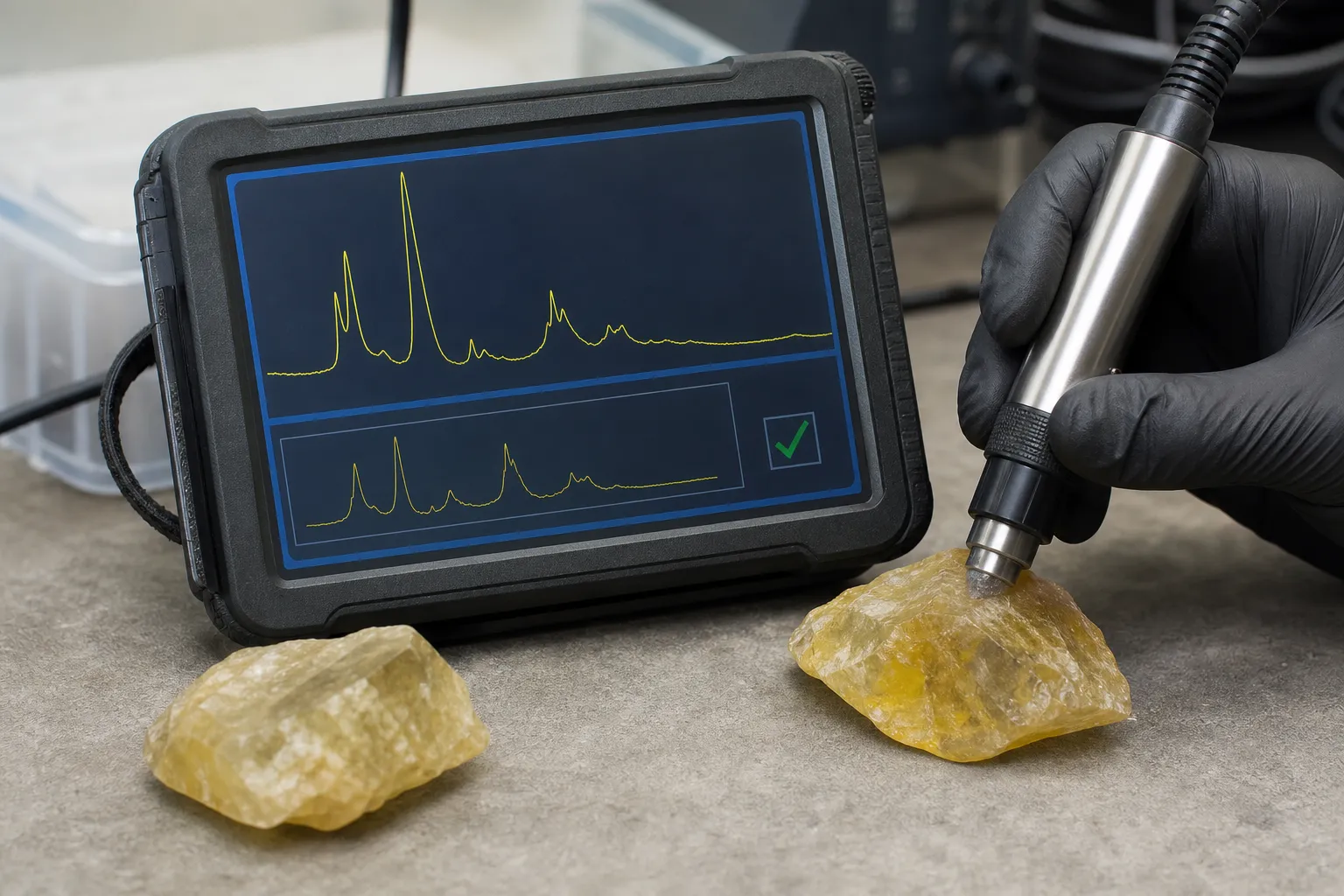
The retail word “baked” is loose. It may refer to heated amethyst sold as citrine, heat-enhanced color in other stones, dyeing, coating, irradiation, resin filling, or simply a suspicion that the color looks too intense. Raman spectroscopy does not treat all of those as one category.
Heat is the main trap. Heating can change color without changing the basic mineral identity. A heated quartz crystal is still quartz. So a Raman mineral identification result may look reassuring while leaving the color-origin question open.
Dyeing and coating create a different problem. If a surface layer has its own Raman signature and the laser interacts with that layer, the device may detect something inconsistent with the claimed material. But if the treatment is thin, patchy, transparent, weakly scattering, or masked by fluorescence, it may not appear clearly. One clean reading from one spot should not be stretched into a whole-stone conclusion.
Synthetic and imitation materials add another boundary. Raman can often help separate mineral groups or identify unexpected phases, but synthetics may share the same basic mineral structure as natural stones. Synthetic corundum and natural corundum are both corundum. Natural quartz and lab-grown quartz both belong to quartz. Raman mineral identification does not automatically determine geological origin.
Inclusions can be useful, too, but they are not simple labels. Raman can identify some inclusions, and gemological work uses it for that purpose. The significance of an inclusion still depends on the species, growth features, locality context, and treatment history.
Portable Raman limitations that matter for crystal screening
The main limitations are practical, not just technical.
Fluorescence is one of the common obstacles. Some stones emit broad fluorescence under the laser, which can overwhelm the weaker Raman signal. Different excitation wavelengths can change that balance. Longer wavelengths may reduce fluorescence in some cases, while shorter wavelengths can give sharper detail when fluorescence is low.
Calibration matters as well. Raman spectra are interpreted by peak positions and patterns. If the instrument is poorly calibrated, or if sampling conditions create spectral artifacts, a comparison can become less reliable. Published Raman reviews discuss how instrument response, sampling conditions, and correction procedures can affect results.
Portable systems may also miss faint features. Handheld and compact units can work well for strong diagnostic bands in common gemstones, but subtle treatment interpretation may require a laboratory system, a different method, or an expert who knows which markers matter for that species.
Laser interaction is another boundary. Raman is generally valued as non-destructive testing in gemology, but it still uses focused laser light. Technical work on Raman analysis notes that local heating and sample-dependent effects can influence measurements under certain conditions. That does not mean a normal portable reading will damage every stone; it means settings, sample behavior, and operator judgment still matter.
Finally, software libraries are not expert judgment. A device may return a likely match, and that match may be correct, while the treatment question remains unresolved. “Quartz” is a mineral ID. It is not a complete history of the crystal.
A practical way to use Raman before expert confirmation
For a collector or small seller, the most responsible use of a Portable Raman Spectrometer is as a screening tool.
It can sort a claim into three useful buckets:
1. Stronger confidence in the stated mineral.
If the spectrum matches the claimed mineral and the sample is visually consistent, the material identity claim becomes stronger.
2. A clear reason to question the listing.
If a stone sold as one mineral gives a different spectrum, or if a suspicious surface gives signals inconsistent with the claimed material, Raman can flag the piece for closer review.
3. An unresolved treatment question.
If the spectrum confirms the mineral but does not show a treatment-specific clue, the honest result is: identified, not fully explained. For heated citrine-like quartz, that may be exactly where the evidence stops.
The next step depends on value and consequence. For an inexpensive curiosity, a mineral ID may be enough. For a higher-value stone, resale claim, or natural-origin statement, Raman should be paired with conventional gemological observation and, when needed, qualified laboratory testing. The more specific the claim—natural color, untreated, geographic origin, no enhancement—the more evidence it needs.
A loupe asks what the eye can see. Raman asks what the structure can scatter back. That is a better question, but not an unlimited one. For baked or treated crystals, portable Raman can expose mismatches and sometimes reveal treatment clues. It cannot replace species-specific evidence, reference spectra, and trained interpretation when the claim moves from “what is it?” to “what happened to it?”